
This is a grammar school presentation for sixth-formers. Their school, rightly, asks them not to use AI for their studies: their work must be their own. The workplace they’re heading into will expect them to use AI expertly from their first day. This talk is about bridging those two worlds, and why the first one prepares them for the second.
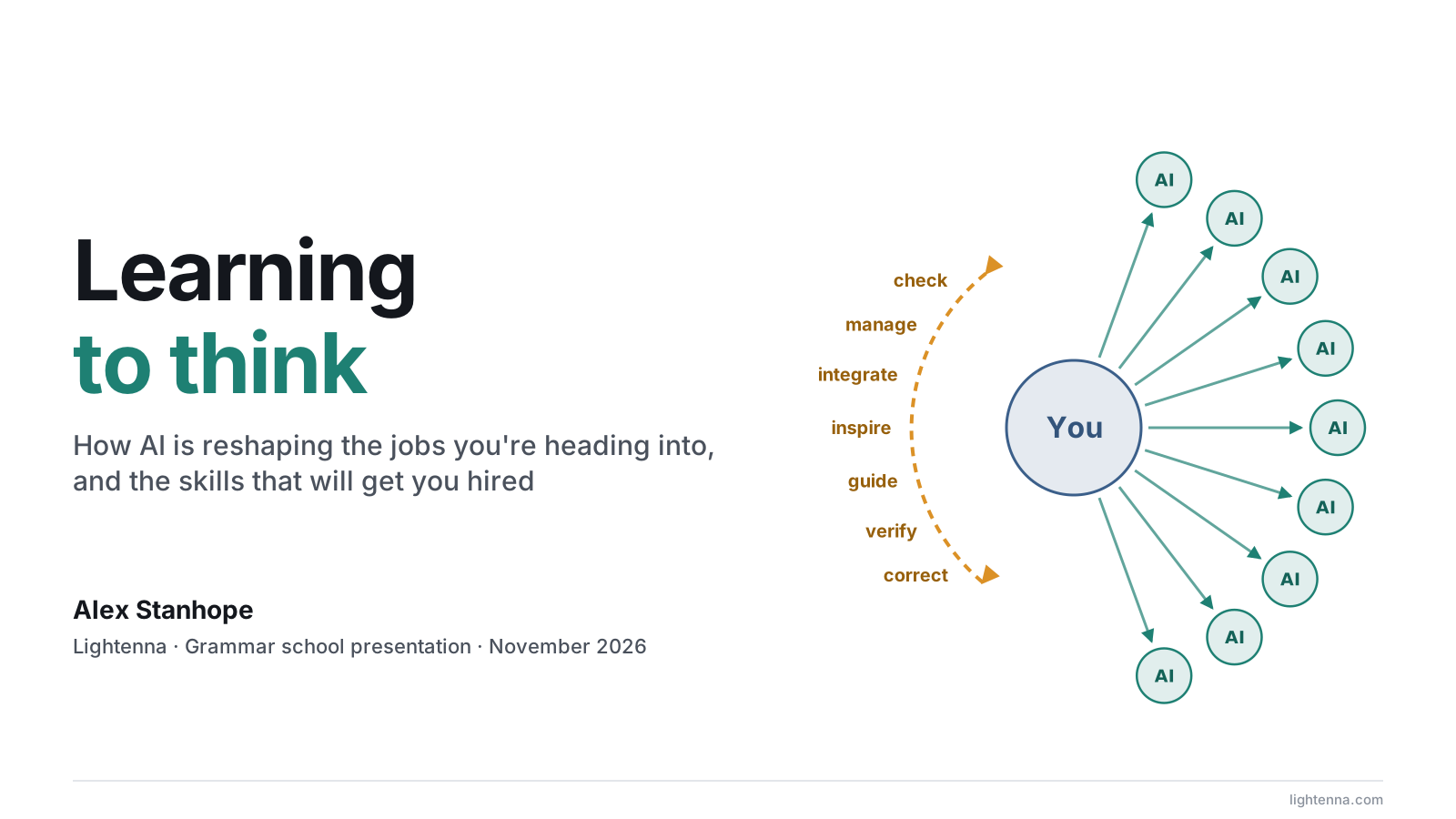
The day you leave education, the rules change completely. Today is about what changes, and how you can be ready for it.
How do you win at chess?
How an AI learns
A clip from The Thinking Game (2024, Tribeca official selection), the documentary about Demis Hassabis and Google DeepMind. Google DeepMind put the full film on YouTube for free in November 2025. The clip runs from 10:03 to 12:40.
What happens in the clip: around 2013, DeepMind gave one algorithm the screen pixels and the score of old Atari games, and nothing else. It couldn’t even play Pong at first, and Demis Hassabis nearly gave up: “Maybe we’re just wrong, and we can’t even do Pong.” Then it scored its first point, then won a game, and three months later no human could beat it. In Breakout it went from missing the ball after 100 games, to human level after 300, to inventing the tunnel trick after 500.
This is from a documentary about Google DeepMind, the London company behind some of the biggest breakthroughs in AI. They gave an AI an old video game, Pong, and told it nothing: not the rules, not what the controls do. All it could see was the screen and the score. Watch how good it is at the start, and how good it is at the end.
That AI was terrible to start with. It got better by doing the game, again and again, getting feedback from the score, and improving. That’s exactly how you learn too, and it’s why your school wants your work to be your own. The same team went on to build AlphaFold, which won the 2024 Nobel Prize in Chemistry and has been used by more than 3 million researchers in over 190 countries, on everything from new medicines to plastic-eating enzymes. AI went from failing at Pong to helping win a Nobel Prize in about ten years. Imagine what it will help you do in the next ten.
Watch the full film: The Thinking Game, Google DeepMind on YouTube · Source: Google DeepMind, AlphaFold: five years of impact
Your job, rewired
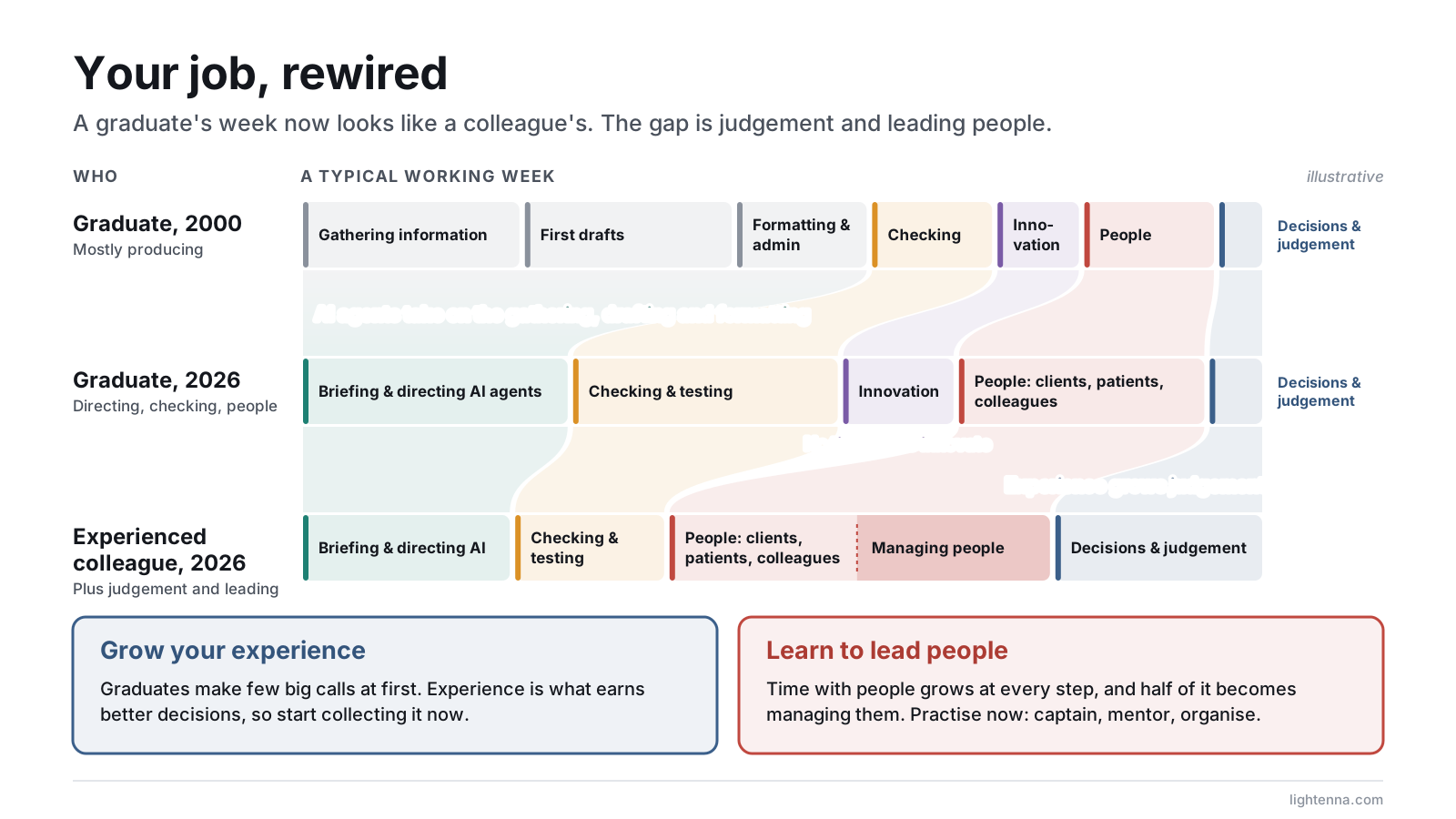
Three working weeks. The bars are illustrative, not measured, but the direction is clear across almost every profession.
- A graduate in 2000 spent most of the week producing: gathering information, writing first drafts, formatting. Graduates were expected to bring some new ideas, but there wasn’t much time for it, and very little time making decisions. That’s how juniors learned, slowly, by doing the routine work.
- A graduate in 2026. AI agents now take on most of that producing. The time goes to briefing and directing them, checking and testing what comes back, working with clients, patients and colleagues, and more innovation than in 2000: with AI doing the producing, new graduates have the time and the fresh eyes to try new ideas.
- An experienced colleague in 2026. Look how similar their week is to the graduate’s. Notice what’s gone: innovation. They’re too busy doing the job, which is why a graduate’s fresh ideas are worth so much to a team. They brief AI, check its work and deal with people too. Only two things are different: they spend far more time on decisions and judgement, and their time with people keeps growing until half of it is managing people. The red pill grows at each step: small in 2000, bigger for a graduate today, biggest for a colleague.
So the step from graduate to colleague is two things. Grow your experience, because that’s what earns good judgement. And learn to lead people. You can start both now: every team you captain, every younger student you mentor, every event you organise.
Why your school’s rule is right. Judgement comes from doing the work yourself. It’s like learning arithmetic before using a calculator: unless you can do it yourself, you can’t tell when the answer is absurd.
Health, science and education
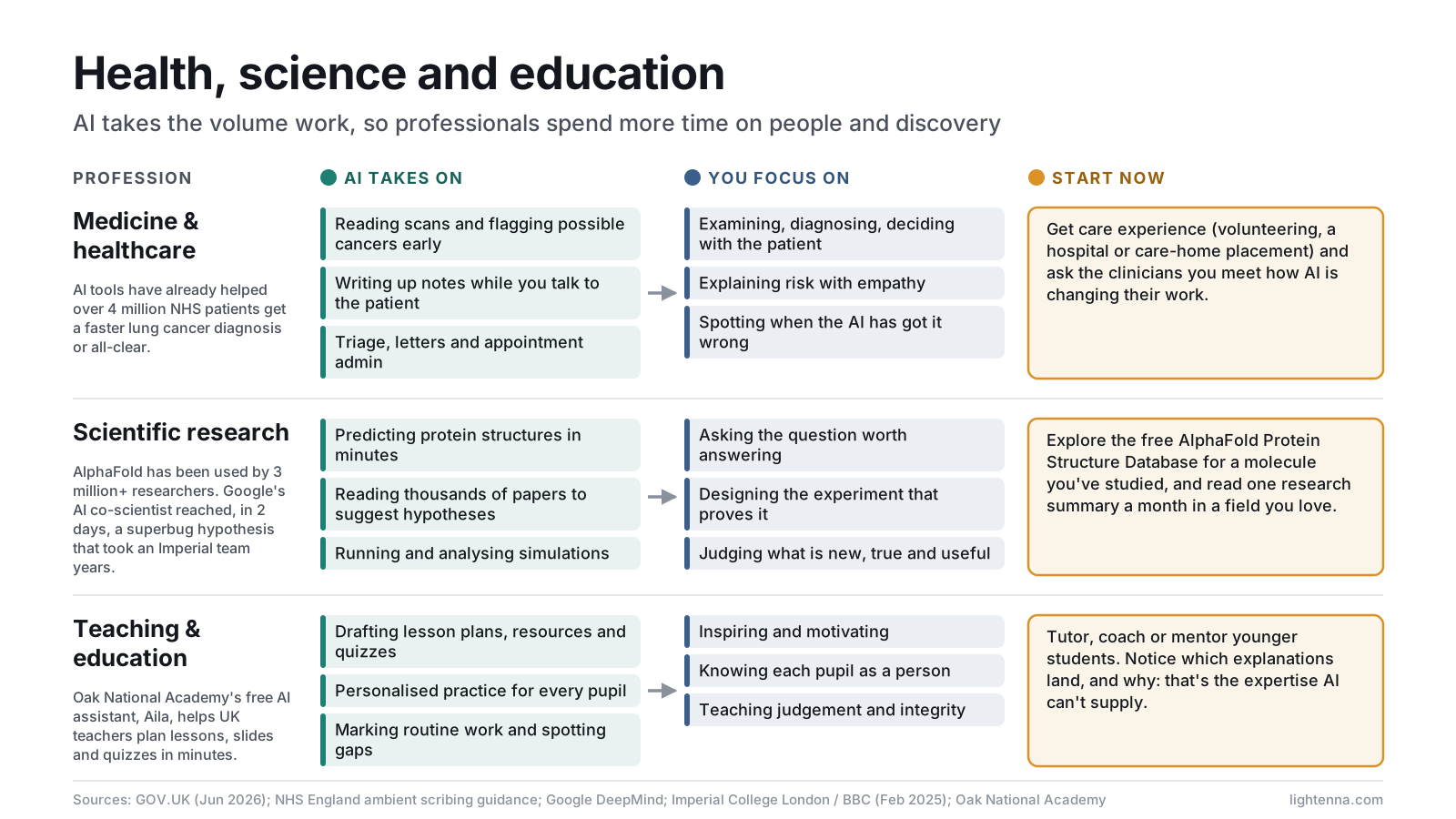
- Medicine. AI reads scans and flags possible cancers. Ambient “scribes” write up notes while the doctor talks to the patient, so the doctor can look at the patient, not the screen. The human part grows: examining, explaining risk, deciding together, and noticing when the AI is wrong. GOV.UK: AI to speed up cancer diagnosis for millions of NHS patients · NHS England: guidance on AI-enabled ambient scribing
- Scientific research. Google’s AI co-scientist proposed, in two days, the same hypothesis about how superbugs spread resistance that Professor José Penadés’s team at Imperial College had spent years working towards. His reaction: “Had we started with this hypothesis, it would have saved us years.” Proving it still took scientists. BBC: AI cracks superbug problem in two days that took scientists years · AlphaFold Protein Structure Database
- Teaching. Teachers use AI to draft lessons and quizzes so they can spend their time on pupils. Oak National Academy’s free assistant, Aila, is used by tens of thousands of UK teachers. Oak National Academy: questions about Aila answered
Law, finance and business
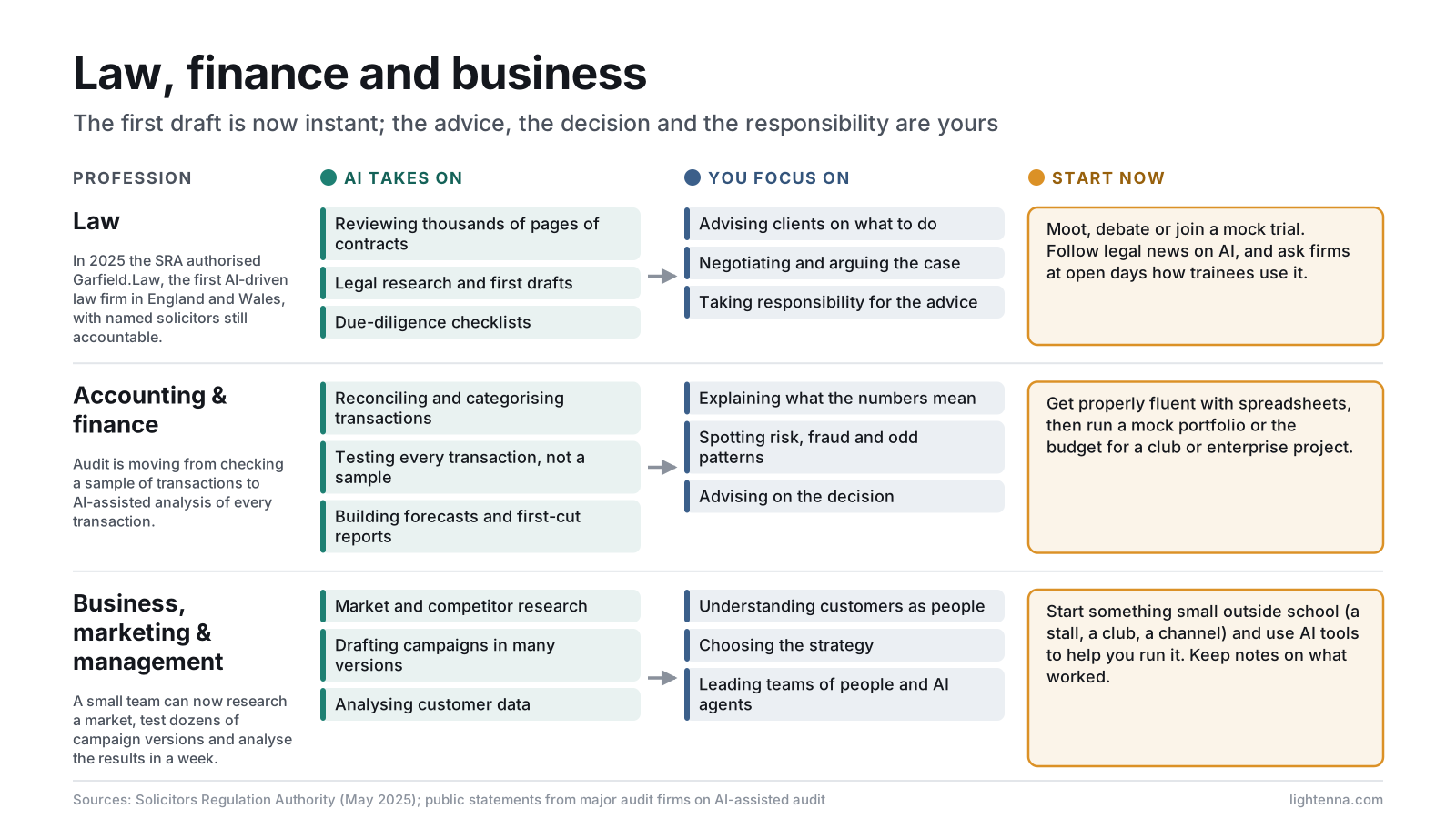
- Law. Reviewing thousands of pages of contracts used to be a trainee’s whole year. Now AI does the first pass, and trainees spend more time on what the documents mean for the client. In May 2025 the Solicitors Regulation Authority authorised Garfield.Law, the first AI-driven law firm in England and Wales. Named solicitors are still accountable for everything it does. Someone always has to stand behind the advice. SRA: SRA approves first AI-driven law firm
- Accounting and finance. Audit used to mean checking a sample of transactions. AI makes it practical to analyse all of them, so accountants spend more time on what the anomalies mean and on advising.
- Business and marketing. A small team can research a market, test dozens of versions of a campaign and analyse the results in days. What doesn’t change: understanding customers as people, choosing a strategy, and leading a team, which will increasingly include AI agents.
Software, engineering and the creative industries
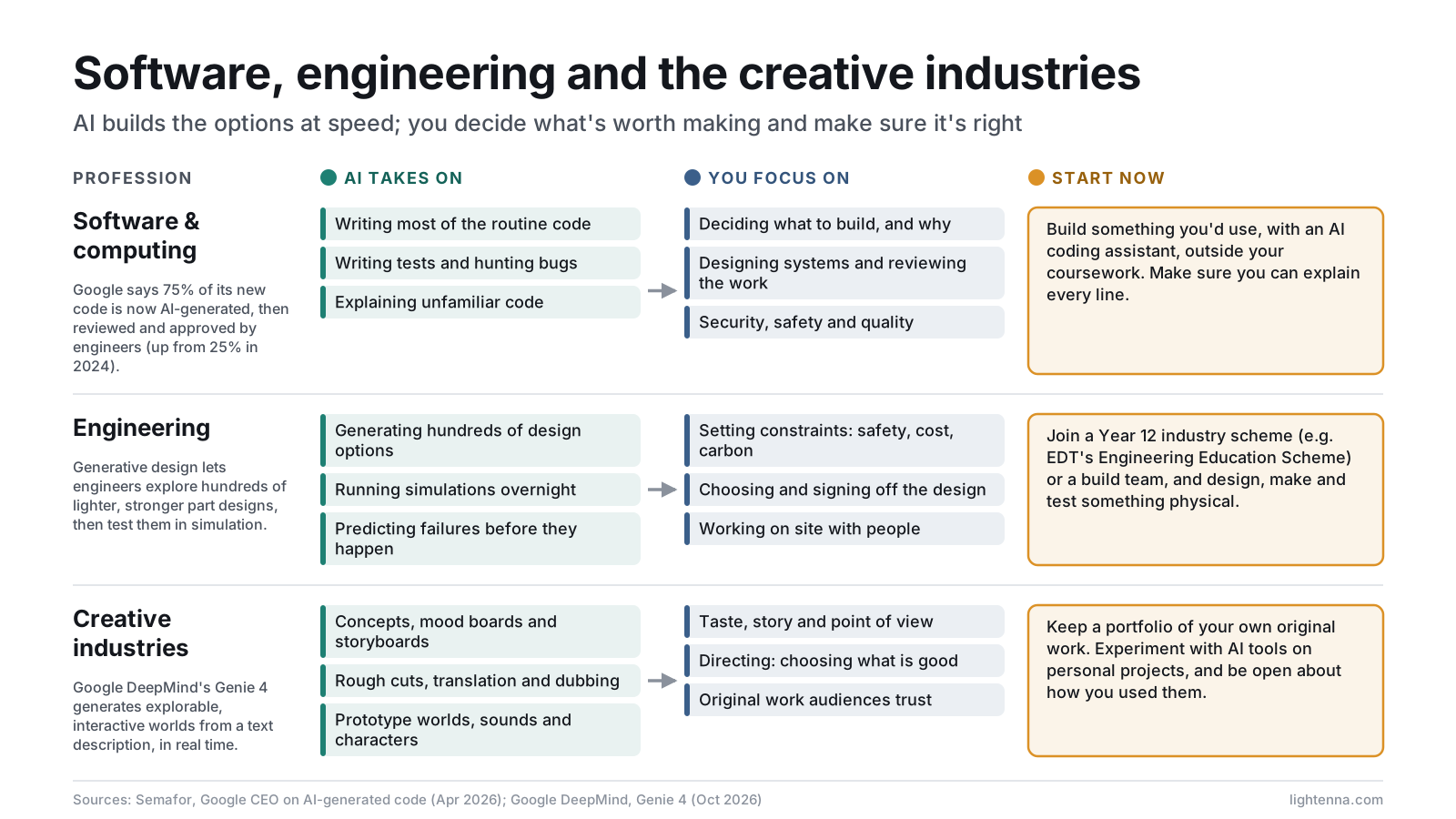
- Software. In April 2026 Google’s CEO said 75% of the company’s new code is AI-generated and then reviewed and approved by engineers, up from about 25% in late 2024. Software engineers haven’t disappeared. Their job has moved to deciding what to build, designing systems and reviewing the work. Semafor: Google CEO says 75% of company’s new code is AI-generated
- Engineering. Generative design and simulation let engineers explore hundreds of options before anything is built. The engineer sets the constraints (safety, cost, carbon), chooses the design and signs it off. Year 12 industry schemes: Engineering Development Trust
- Creative industries. Google DeepMind’s Genie 4, announced at the end of October 2026, generates interactive worlds you can walk around in, from a text description. AI makes ideas cheap to try. Taste, story and a point of view are what make the work worth watching, and audiences increasingly want to know a human was behind it. Google DeepMind: Genie 4
The AI-fluent expert
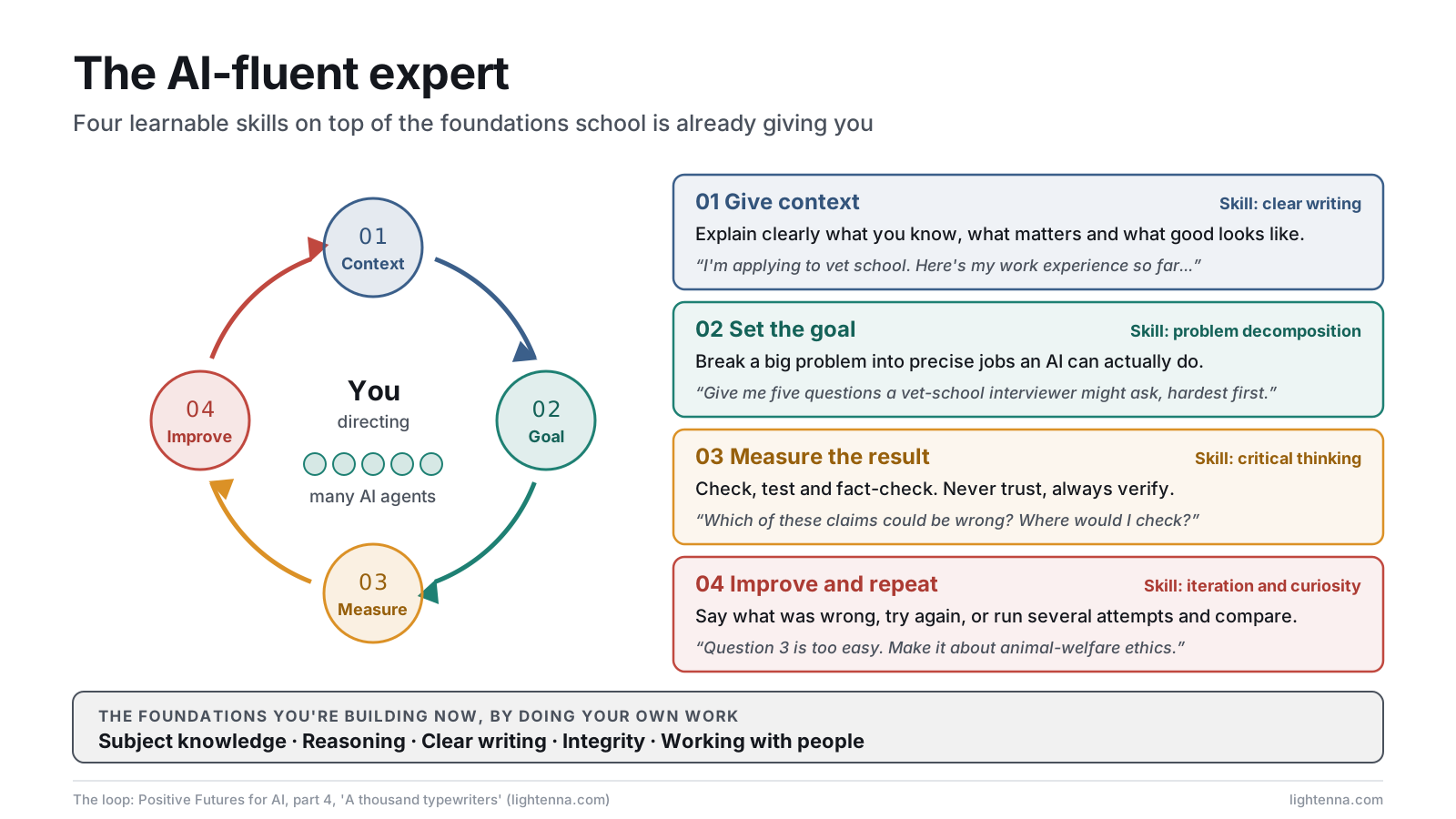
The skills are learnable, and quickly. Getting good results from AI isn’t about magic prompts. It’s a loop:
- Context. Tell it what you know, what matters and what good looks like. Skill: clear writing.
- Goal. Turn a big problem into precise jobs. Skill: problem decomposition.
- Measure. Check, test and fact-check everything. Skill: critical thinking.
- Improve. Say what was wrong, try again, or run several attempts and compare. Skill: iteration and curiosity.
The vet-school example on the slide is a real use, outside assessed work, that makes you better prepared.
Every one of those skills sits on foundations you’re building right now, by doing your own work: subject knowledge, reasoning, clear writing, integrity and working with people. The loop is easy to learn. The foundations take years, and you’re already building them.
More on the loop: Positive Futures for AI, part 4: A thousand typewriters
Limited physics, expert AI
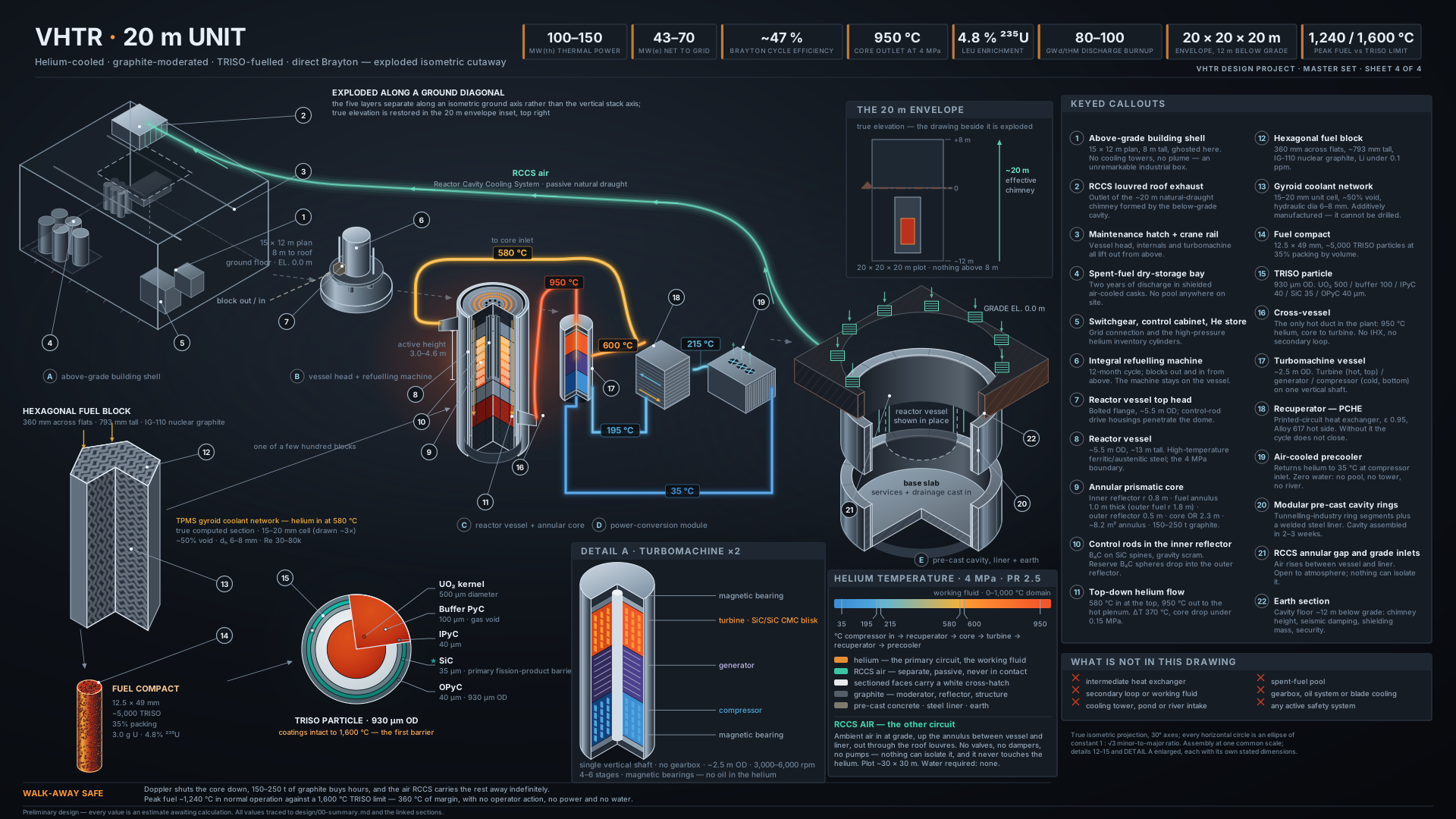
A very high temperature reactor, designed with AI. This is one sheet from a design set for a helium-cooled, graphite-moderated reactor that turns itself off if something goes wrong. I have no background in nuclear physics. What I do have is expert AI knowledge: giving it context, setting precise goals, checking every result and going round the loop again, many times. That’s the loop from the previous slide, applied to something far more complex than I could have designed alone. It’s a preliminary design study, not an approved reactor, and the checking never stops.
The mistergy design set on GitHub · Positive Futures for AI, part 4: A thousand typewriters
Your head start
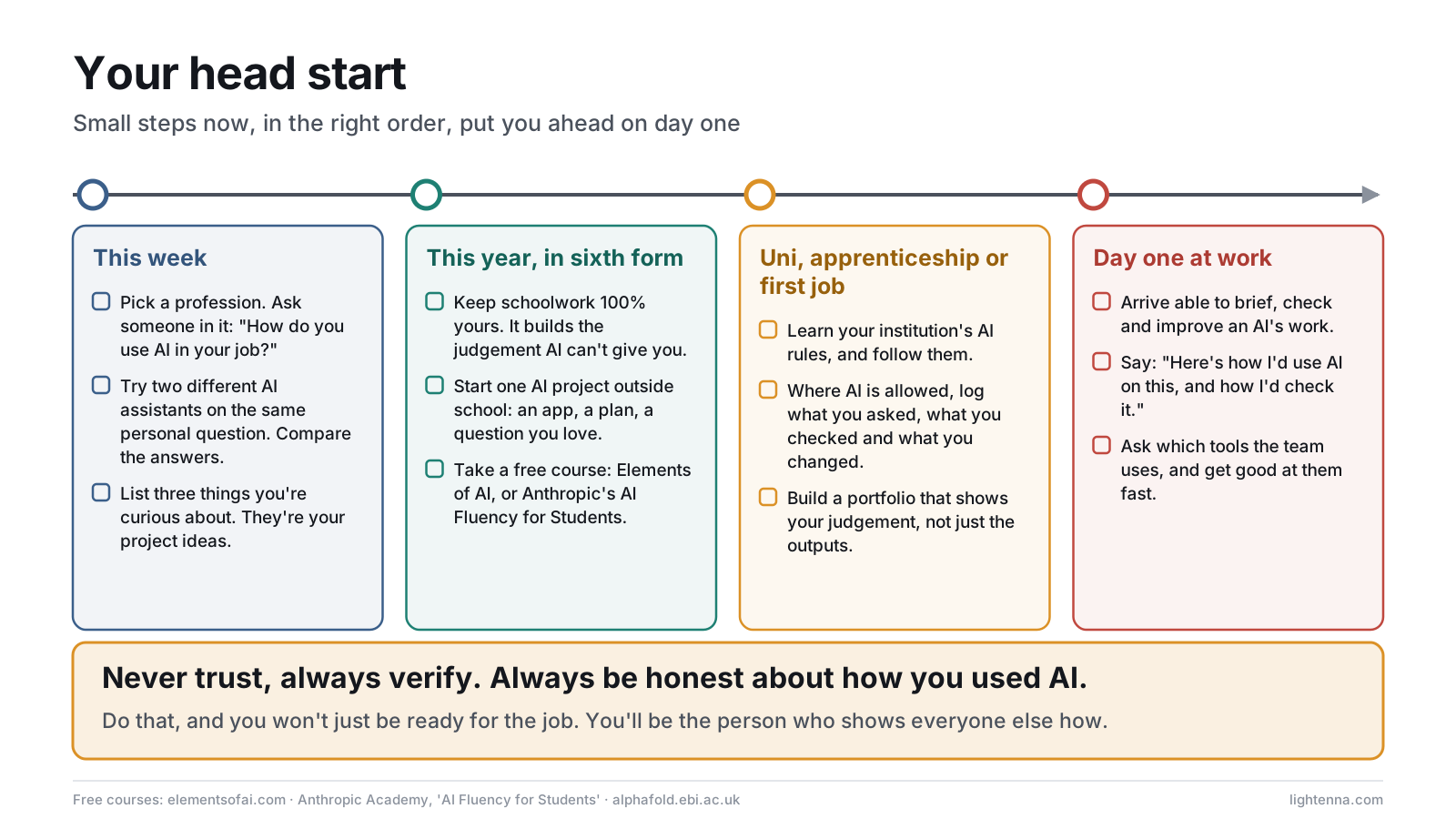
- Outside schoolwork only. Every AI action on this slide happens outside assessed work. Schoolwork stays 100% yours.
- Free places to start: Elements of AI (University of Helsinki) and AI Fluency for Students (Anthropic, free on Coursera).
- The golden rule. Never trust, always verify, and always be honest about how you used AI. Do that, and you won’t just be ready for the job. You’ll be the person who shows everyone else how.
Questions
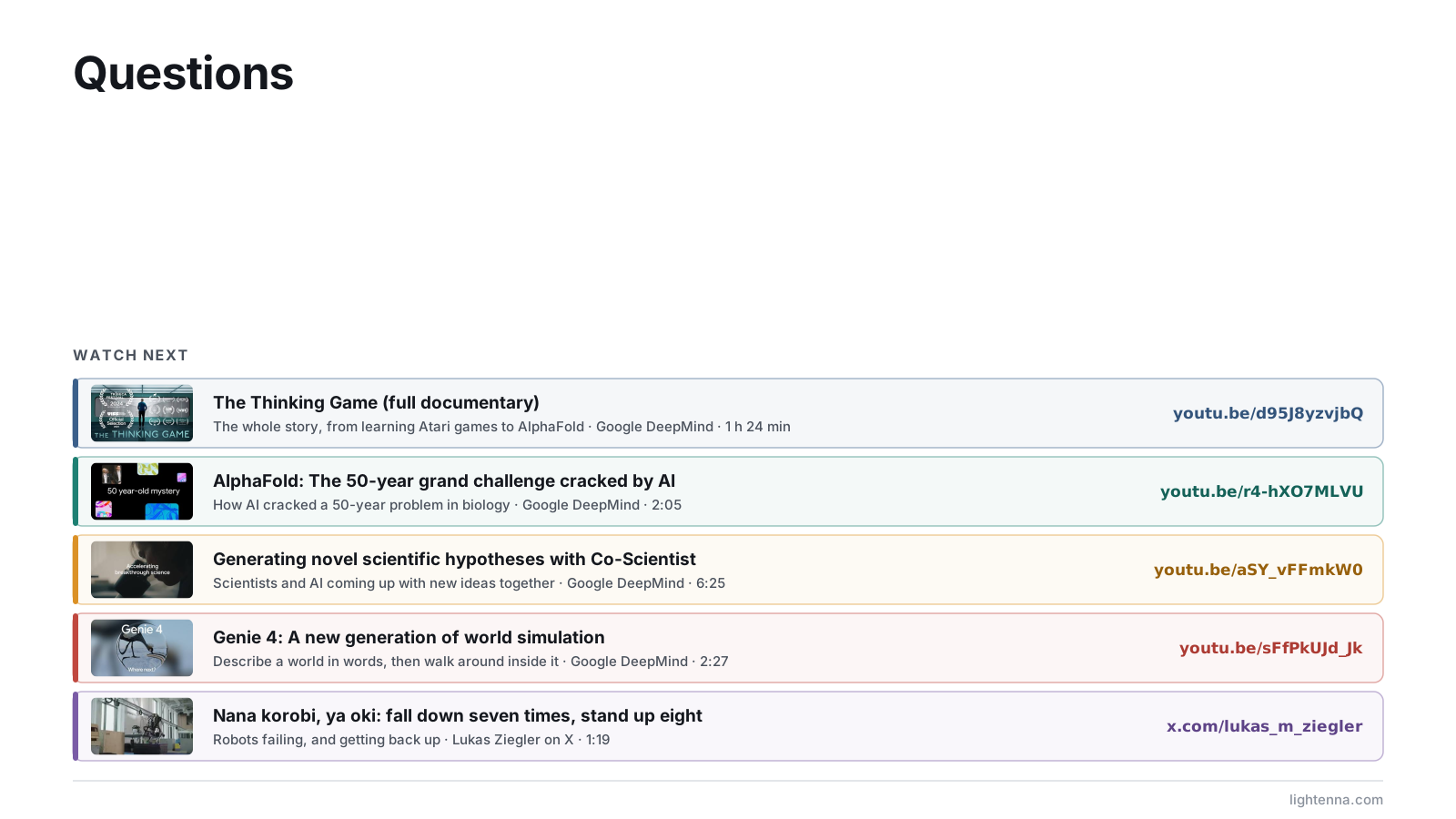
Five videos for anyone who wants more.
- The Thinking Game (full documentary), Google DeepMind, 1 h 24 min. The whole story, from Atari games to AlphaFold. Today’s clip starts at 10:03.
- AlphaFold: The 50-year grand challenge cracked by AI, 2 min 5 s, November 2025.
- Generating novel scientific hypotheses with Co-Scientist, 6 min 25 s, May 2026.
- Genie 4: A new generation of world simulation, 2 min 27 s, October 2026.
- Nana korobi, ya oki, Lukas Ziegler on X, 1 min 19 s, November 2022. “Fall down seven times, stand up eight”: robots failing, and getting back up.
Previously in the series: Part 4: A thousand typewriters
Leave a comment